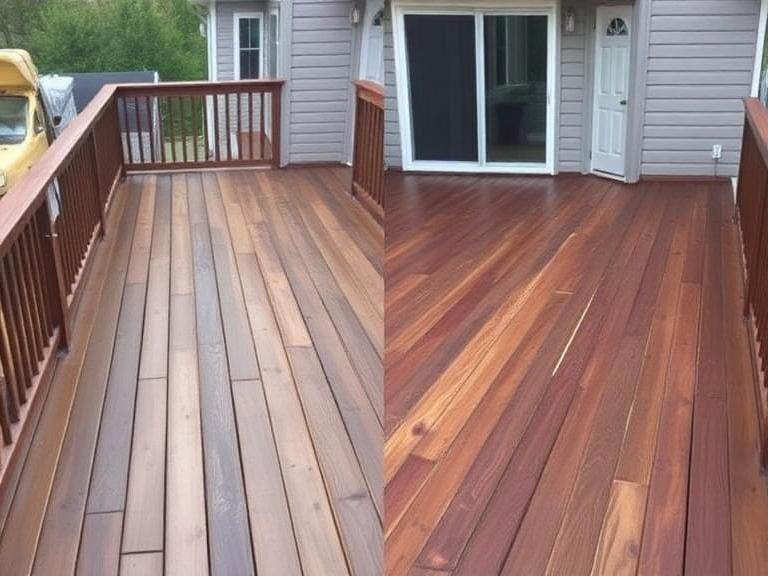
Chicago homeowners keep pouring stain on decks that need scraping, and the boards keep failing every spring. The bill grows, the callbacks stack up, and the wood underneath never gets a chance to breathe.
The problem is seldom the product. Layer under layer of pigment traps moisture, boards cup and split, and fasteners loosen inside a season of freeze-thaw.
A serious deck restoration engagement begins with the work other quotes skip. It reads moisture with a meter, strips old coating with sodium percarbonate, checks joists and ledger connections for rot, and lets pressure-treated pine, cedar, or ipe dry to the moisture content the coating requires.
The payoff is a deck that holds four to six years on cedar, longer on pressure-treated pine, and about a decade on ipe.
Over-Coating Is the Trap Behind Every Failed Deck
Every failed deck we see is a deck that was over-coated. Layer under layer of pigment traps moisture in the grain, and the grain gives up.
Boards cup, split, and lift off their fasteners.
The first job on any serious restoration is stripping. Sodium percarbonate cleaner opens the pores, oxalic acid brightener resets the color, and a scraper takes off whatever the chemistry loosens.
Sand after the wood shows you what it wants to become.
A power washer set above 1,500 psi will hollow the summerwood between the growth rings, leaving fuzzy channels that soak stain and swell in the next rain. Chemistry does the work power cannot do without damage.
Anyone who quotes a deck restoration without factoring in the stripping hours is quoting a re-coat. Restoration and re-coating are two different jobs, and the second buys eighteen months.
The Moisture Reading No Stain Can Beat
Wood carries water in ways homeowners underestimate. A board that reads dry on the surface can still hold twenty percent moisture two millimeters below, which is enough to blow any coating off within a season.
Pressure-treated pine, cedar, and ipe each behave in a different way after washing.
Pressure-treated pine wants seventy-two hours of dry weather before staining. Cedar wants five to seven days.
Ipe wants two weeks and a light sanding to open the grain, because oil-rich tropical hardwoods reject stain the way a waxed car rejects water.
Composite decking has its own restoration path, closer to a cleaning problem than a coating one, and the failures come from the wood substructure underneath instead of the boards on top.
Check moisture with a meter before you open the can. A meter reading beats any forecast, especially in a Chicago week that shifts overnight.
Five Steps That Kill Restoration Callbacks
Deck restoration is an order-of-operations problem. The sequence a crew follows is what buys the five-year finish.
Every callback we field on a botched restoration traces back to a skipped step or a step performed out of order.
Here is the sequence that works on Midwestern decks:
- Inspect and mark rot at joists, ledger, and stair stringers before any cleaning.
- Replace compromised boards and hardware while the deck is dry.
- Wash with an alkaline cleaner, then neutralize with a brightener.
- Let the wood dry to the moisture content the coating manufacturer specifies.
- Sand any raised grain, remove dust, and apply thin coats of a penetrating stain.
Skip step two, and you will stain over rot. Skip step four, and you will stain over water.
Both mistakes look fine for a month.
Corroded Screws Bleed Through a Fresh Finish
The boards get all the attention. The screws and concealed clips carry the load-bearing work of a restoration.
Corroded fasteners telegraph through any new finish within a year. Rust streaks bleed from the head, the wood around the screw softens, and the board loosens on the joist below.
A restoration that leaves original 2005 galvanized screws in place is a restoration with an expiration date printed on it.
The joists below the boards are the other invisible variable. A restoration that skips inspecting the ledger connection to the house is a restoration that puts new stain on a structure the code no longer approves.
Replace with stainless where the deck sees salt air or heavy freeze-thaw. Upgrade to concealed fastener systems on boards that will be sanded flat.
Thin Coats Outlast the Gallon You Just Bought
Thin coats last longest on decks that see Chicago freeze-thaw. Homeowners still tend to buy for thickness, because thicker feels like more protection and more feels like better value.
Chemistry matters more than the brand on the can. Penetrating oils push pigment into the fiber, and film-forming acrylics sit on top until the peel starts.
Choose the chemistry to match the wood, the exposure, and the maintenance schedule the homeowner will keep.
Pigment load determines UV protection. Transparent finishes look good for three months and give out sooner.
Semi-transparents split the difference.
Solid stains protect longest and give up the grain, which is the tradeoff a homeowner has to weigh with open eyes.
Sherwin-Williams, Benjamin Moore, and specialty brands each have their loyalists. The product argument is smaller than the prep argument.
The Seven-Day Forecast Decides the Restoration
A deck is a piece of furniture the size of a room, held together by weather that cycles through every extreme Chicago can produce. The seven-day forecast decides more of the outcome than the gallon of stain sitting on the garage shelf.
Three signals mark the workable window: humidity below seventy percent, two days of overnight lows above fifty, and wood that has darkened to a uniform tone after the brightener rinse.
Chicago decks sometimes live through four seasons in three days. A restoration performed in the right window holds four to six years on cedar, longer on pressure-treated pine, and about a decade on ipe with maintenance.
Skip the window, and the coating peels inside six months.
Restoration is a slow trade practiced by people willing to say no to a Saturday. Crews that respect the sequence save boards that would otherwise be pulled and replaced.
Think of the deck as a wooden animal that lives outside. Feed it what it can absorb, keep its skin dry, and pull off anything that stops it from breathing.
Do that, and the restoration will last.
Also Read: The Ultimate Guide to TheHomeTrotters Blog Home Ideas for Stylish and Functional Modern Homes