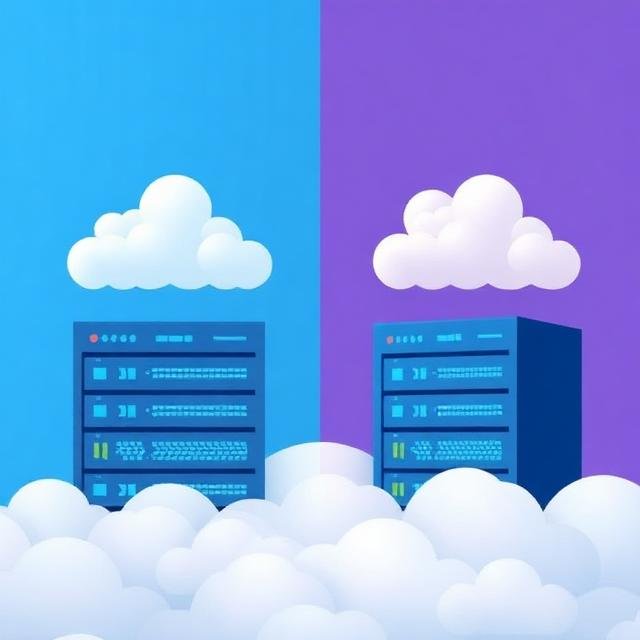
As businesses and individuals increasingly move online, choosing the right hosting solution has become more important than ever. Two of the most commonly discussed options are cloud computing and traditional hosting. While both serve the purpose of storing and delivering data or websites, they differ significantly in structure, performance, scalability, and cost.
In this detailed guide, we’ll break down cloud computing vs traditional hosting, explain their differences point by point, and answer key questions like:
- What is the difference between cloud hosting and traditional hosting?
- What is the difference between hosting and cloud?
- Is cloud computing better than traditional computing?
- What are the 4 types of hosting?
What Is Traditional Hosting?
Traditional hosting refers to a setup where your website or application is stored on a single physical server. This server can be shared with other users or dedicated entirely to you.
Key Characteristics:
- Fixed resources (CPU, RAM, storage)
- Single server dependency
- Limited scalability
- Usually cheaper for small websites
Traditional hosting has been the backbone of the internet for decades and is still widely used for simple websites, blogs, and small businesses.
What Is Cloud Computing?
Cloud computing, on the other hand, uses a network of interconnected virtual servers instead of a single physical machine. Your data is distributed across multiple servers, often located in different regions.
Popular providers include companies like Amazon Web Services, Microsoft Azure, and Google Cloud Platform.
Key Characteristics:
- Scalable resources (pay as you go)
- High availability (no single point of failure)
- Flexible infrastructure
- Suitable for modern apps and growing websites
What Is the Difference Between Cloud Hosting and Traditional Hosting?
This is one of the most common questions, and the difference lies in architecture, flexibility, and performance.
1. Infrastructure
- Traditional Hosting: Runs on a single physical server
- Cloud Hosting: Uses multiple virtual servers connected in a network
Cloud hosting is more resilient because it doesn’t rely on just one machine.
2. Scalability
- Traditional: Limited—you must upgrade manually
- Cloud: Instant—you can scale resources up or down anytime
This makes cloud hosting ideal for websites with fluctuating traffic.
3. Reliability
- Traditional: If the server fails, your website goes down
- Cloud: If one server fails, another takes over
Cloud hosting offers significantly higher uptime.
4. Cost Structure
- Traditional: Fixed monthly or yearly pricing
- Cloud: Pay-as-you-go pricing
Cloud can be cost-efficient but unpredictable if not managed properly.
5. Performance
- Traditional: Performance depends on one server
- Cloud: Load is distributed across servers
Cloud often provides faster and more stable performance.
What Is the Difference Between Hosting and Cloud?
This question can be confusing because cloud is actually a type of hosting.
Hosting (General Term)
“Hosting” refers to any service that stores your website or data on a server and makes it accessible online.
Cloud (Specific Type)
Cloud computing is a modern hosting method that uses distributed infrastructure.
In simple terms:
- Hosting = broader category
- Cloud = advanced form of hosting
Is Cloud Computing Better Than Traditional Computing?
The answer depends on your needs—but in most modern scenarios, yes, cloud computing is better.
Advantages of Cloud Computing
1. Scalability
You can instantly increase or decrease resources based on demand.
2. High Availability
Cloud systems are designed to avoid downtime.
3. Cost Efficiency
You only pay for what you use.
4. Remote Access
Access your data from anywhere in the world.
5. Security Improvements
Top providers invest heavily in security infrastructure.
When Traditional Hosting Might Be Better
Despite cloud advantages, traditional hosting still has use cases:
- Small static websites
- Low-budget projects
- Applications that don’t need scaling
- Full control over a single server
For simple needs, traditional hosting can still be a practical choice.
What Are the 4 Types of Hosting?
Understanding the types of hosting helps you choose the right solution.
1. Shared Hosting
- Multiple websites share one server
- Cheapest option
- Limited performance
Best for beginners and small blogs
2. VPS Hosting (Virtual Private Server)
- Server is divided into virtual environments
- More control and better performance than shared hosting
Best for growing websites
3. Dedicated Hosting
- Entire server dedicated to one user
- High performance and full control
- Expensive
Best for large businesses and high-traffic websites
4. Cloud Hosting
- Uses multiple servers instead of one
- Highly scalable and reliable
Best for modern applications and scaling businesses
Cloud Computing vs Traditional Hosting: Point-to-Point Comparison
| Feature | Traditional Hosting | Cloud Computing |
|---|---|---|
| Infrastructure | Single server | Multiple servers |
| Scalability | Limited | Highly scalable |
| Reliability | Lower | Very high |
| Pricing | Fixed | Pay-as-you-go |
| Performance | Moderate | High |
| Flexibility | Low | High |
| Downtime Risk | Higher | Minimal |
Real-World Example
Imagine you run an online store:
- With traditional hosting, your website might crash during high traffic (like sales events).
- With cloud computing, resources automatically scale to handle traffic spikes.
This is why most modern businesses prefer cloud solutions.
When Should You Choose Cloud Computing?
You should choose cloud computing if:
- Your website traffic changes frequently
- You run apps or SaaS platforms
- You need high uptime
- You want flexibility and scalability
When Should You Choose Traditional Hosting?
You should choose traditional hosting if:
- You have a small website
- Your traffic is predictable
- You want a fixed cost
- You prefer a simple setup
Future of Hosting: Cloud Dominance
The future clearly leans toward cloud computing. Major companies like Amazon Web Services and Google Cloud Platform continue to expand their infrastructure globally, making cloud solutions more accessible and powerful.
Traditional hosting is gradually becoming less popular for large-scale applications, though it still has its place in specific scenarios.
Final Thoughts
Choosing between cloud computing and traditional hosting ultimately depends on your needs, budget, and technical requirements.
Quick Summary:
- Cloud computing = scalable, reliable, modern
- Traditional hosting = simple, fixed, budget-friendly
If you’re building something for the future, cloud is usually the smarter choice.
If you’re running something small and stable, traditional hosting still works.